

By Edilina Keithleen Barroga, Keith Candice Diño Marking the beginning of a month-long devotion, a program was held at the school quadrangle during the morning ceremony to officially launch the Month of the Holy Rosary. To start, the program began with a doxology led by the Salindayog Cultural Dance Troupe, setting a reverent tone for…



When Sanctuaries Scream: The Fractured Dreams and Echoing Cries for Justice
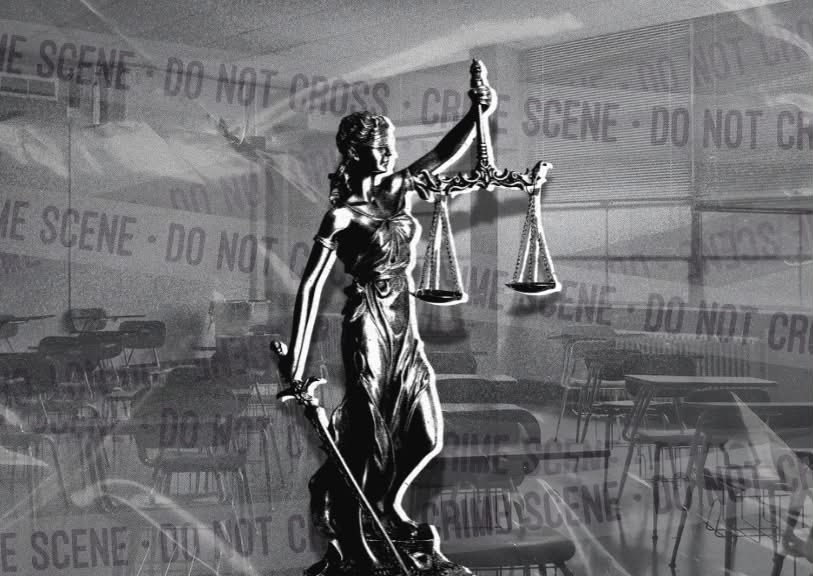
Layout by Aimee Therese Agustin
The spaces that once hummed the vibrant, innocent energy of youth have fallen into a breathless silence.
Classrooms meant for honing young minds and basketball courts built for chasing dreams have transformed into theaters of unimaginable grief. In a flash of violence, bright futures were stolen, families were shattered, and an unyielding demand for justice now dominates the room.
As the smoke clears from these sudden tragedies, our society is forced to look into a complex, deeply painful mirror—wrestling with how a nation balances the cry for retribution with the cold boundaries of the law.
When violence strikes within a school, the heartbreak carries a unique weight, as the perpetrators are sometimes children themselves.
In the recent Tacloban school shooting, the hands that pulled the triggers belonged to minors aged just 14 and 15, forcing us to confront the delicate mechanics of the Juvenile Justice and Welfare Act, or Republic Act No. 9344. Under this law, a child 15 years old or below is exempt from traditional criminal liability, guided instead toward intense intervention programs within specialized facilities like the Intensive Juvenile Intervention and Support Center of a Bahay Pag-asa.
For those who fall into the fragile bracket above 15 but below 18, their entire legal destiny hinges on a single, profound legal concept known as discernment.
Discernment is not merely the basic awareness of right and wrong; as defined by the Supreme Court’s Revised Rule on Children in Conflict with the Law. It is the actual mental capacity to fully appreciate the horrific consequences of an unlawful act.
The law offers no automatic presumption that a child possessed this maturity, placing the entire burden on the prosecution to prove it beyond reasonable doubt. To measure something as invisible as a child’s mind, the court must carefully examine the totality of the circumstances. Judges look closely at the child’s attitude before, during, and after the bloodshed, the complexity of the crime, any calculated shrewdness, and deliberate attempts to silence witnesses or conceal a smoking gun.
Even when guilt is established, the Philippine justice system prioritizes reformation over raw punishment for the youth.
A minor found guilty automatically receives a suspended sentence, meaning they are not immediately cast into a prison cell.
Instead, they are placed under a supervised rehabilitation program. If a social worker can later certify that the objectives of this intervention have been met by the time the offender reaches legal age, the court may dismiss the case entirely, clearing their criminal liability.
While this legal grace clears their record to allow a second chance at life, it never erases the civil and financial damages owed to the victims’ families, ensuring that the weight of their actions is never truly forgotten.
Yet, with national data showing that children commit less than two percent of total crimes, every tragedy sparks a fierce public debate on whether our current laws truly reform young minds or simply leave the cracks in our society wide open.
While the law wrestles with the psychological nuances and rehabilitation of children, justice takes on a far sharper, less forgiving edge when the shadows of violence fall upon adult shoulders.
On the local basketball courts, where the laughter of youth was also met with untimely death, the demand for accountability offers no shield of leniency. In tragedies that call for absolute adult accountability, there are no delicate debates over mental discernment or suspended sentences.
When adults breach the absolute sanctity of life, the law strips away the patient layers of rehabilitation and replaces them with the swift, punitive weight of conviction.
Ultimately, whether a perpetrator is a child trapped in a cycle of vulnerability or an adult fully aware of their malice, the finality of the grave remains identical.
Grief does not care about the legal age of the person who pulled the trigger, and the mothers weeping over empty beds in Tacloban feel the exact same agonizing pull as the families mourning the bright talents lost on the hardwood courts.
True justice cannot merely be a matter of statutory codes and courtroom declarations; it must be transparent, righteous, and deeply empathetic to those who are left to carry the pieces.
As the long road to healing begins, a nation can only hope that the truth always prevails and that the lives of these grieving families are touched by eventual comfort. Though the pain will never be fully bearable, may the light of hope find them in every small encounter, through supportive people, and through the enduring achievements of their communities.
May the stolen dreams of these young people continue to echo, inspiring a generation of youth to protect the sacred sanctuaries of life, ensuring that our rooms of comfort never have to scream in silence again.