

The International Criminal Court (I.C.C.) has given prosecutors permission to use a previously recorded statement from a witness in the murder and crimes against humanity trial of Former President Rodrigo Roa Duterte (F.P.R.R.D.). In a ruling released on Oct. 2, Trial Chamber III agreed to the prosecution’s request to submit the written testimony of a…


Russian Drone Incursion Delays Zelenskyy’s Departure
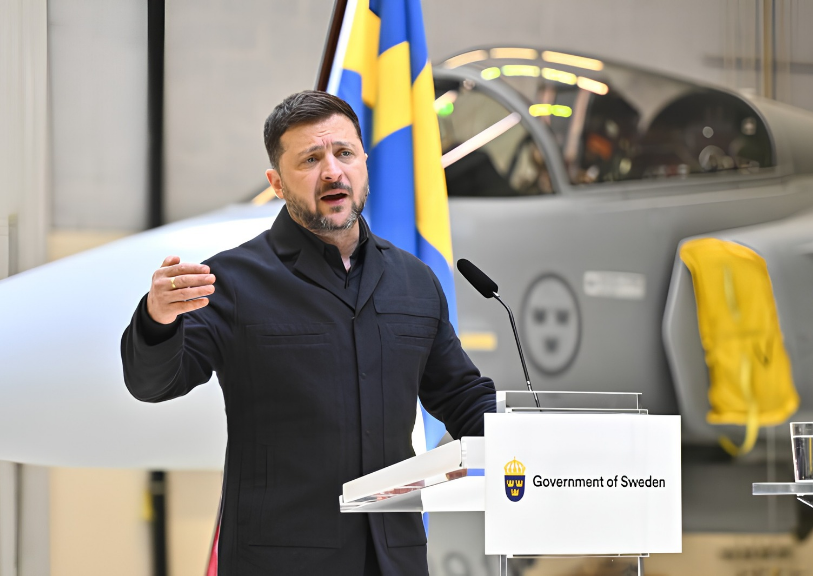
Photo via AP News
Ukrainian President Volodymyr Zelenskyy’s departure from Moldova for Norway was temporarily delayed after Russian drones entered Moldovan airspace, forcing authorities to close the country’s skies and triggering a security alert around the aircraft carrying the Ukrainian leader.
The incident occurred as Mr. Zelenskyy was preparing to travel to Oslo to attend the funeral of Norway’s King Harald V. Moldovan authorities temporarily suspended air traffic after detecting the drone activity, delaying several flights, including the aircraft carrying the Ukrainian president.
The episode took on a more serious dimension after Norwegian Prime Minister Jonas Gahr Støre said Mr. Zelenskyy’s plane had nearly been struck by a drone as it was preparing to leave Moldova.
“His plane was almost hit by a drone as it was about to take off from Moldova,” Mr. Støre said, according to Norwegian public broadcaster NRK, describing the incident as an illustration of the danger Mr. Zelenskyy continues to face because of Russia’s war against Ukraine. Mr. Støre did not publicly explain the source of his information or specify how close the drone came to the aircraft.
Moldovan officials, meanwhile, confirmed that a drone alert had forced the temporary closure of the country’s airspace. They said Mr. Zelenskyy’s aircraft was eventually cleared to depart after authorities established that a Russian drone had come down on Moldovan territory.
Three departures and four arrivals were delayed during the airspace closure.
Russian drones cross into Moldova
Moldovan authorities reported that two Russian drones entered the country’s airspace during the incident.
One drone crashed in a field in the Rîșcani district, roughly 160 kilometers from Chișinău International Airport. The crash caused an explosion and several fires, but authorities reported no injuries.
Police and explosives specialists were sent to the site to examine the wreckage and determine the type of drone and the nature of its payload.
Moldovan police later said explosives experts had recovered fragments with a propulsion system and characteristics similar to a Geran-type drone, a model used extensively by Russia in its war against Ukraine. Investigators were continuing to examine the wreckage to determine the type and weight of the explosive payload.
The second drone reportedly continued from Moldovan airspace into neighboring Romania, a member of the North Atlantic Treaty Organization (NATO) and the European Union.
Romanian authorities tracked the drone as it crossed parts of the country’s northeastern territory. Two F-18 fighter jets operated by the Spanish Air and Space Force were reportedly scrambled to monitor its trajectory before the drone eventually reentered Moldovan airspace.
The movement of the drone across several national airspaces illustrates the growing difficulty neighboring countries face as Russia and Ukraine conduct increasingly extensive long-range drone operations.
Zelenskyy’s aircraft eventually takes off
The temporary airspace closure meant that Mr. Zelenskyy could not leave Moldova according to his original schedule.
Moldovan government spokesperson Dumitru Ciorici said the restrictions were imposed as a precaution to protect aircraft already flying over the country.
Once authorities confirmed that the drone had come down on Moldovan territory, the presidential aircraft was permitted to take off.
The delay was relatively brief, but the circumstances highlighted the unusual security risks surrounding the Ukrainian president’s international travel.
Mr. Zelenskyy has traveled extensively during Russia’s full-scale invasion, visiting European capitals and meeting foreign leaders in an effort to secure military, financial and diplomatic support for Ukraine. His movements are generally subject to extensive security precautions, making the reported proximity of a hostile drone particularly significant.
The Norwegian prime minister’s statement that the aircraft was nearly hit has not been accompanied by publicly released radar data or other evidence establishing the precise distance between the drone and Mr. Zelenskyy’s plane. Ukrainian officials have nevertheless treated the incident as a serious security concern.
Moldova caught in the expanding air war
The incident comes as Moldova has increasingly found itself affected by the war next door.
Although Moldova is not a participant in the conflict and is not a NATO member, its location between Ukraine and Romania has exposed it to the consequences of Russia’s extensive use of drones and missiles.
Moldovan President Maia Sandu condemned the incursions, calling them a serious threat to people’s lives. She also criticized a separate Russian drone attack near the Ukraine-Moldova border in which two people were killed.
For Chisinau, repeated incursions represent more than an aviation problem. They raise broader questions about Moldova’s ability to monitor and respond to aerial threats at a time when the country’s security environment has become increasingly tense.
The government has previously reported Russian drones entering Moldovan airspace during attacks on Ukraine. Each incident raises the possibility that drones could accidentally crash in populated areas or create dangerous situations for civilian aircraft.
The latest episode was particularly sensitive because Mr. Zelenskyy’s aircraft was among those affected.
Romanian involvement underscores NATO concerns
The drone’s reported movement into Romanian airspace added another layer of significance to the incident.
Romania has repeatedly dealt with Russian drone activity connected to the war in neighboring Ukraine. As a NATO member, any Russian military asset entering Romanian airspace has the potential to trigger a broader alliance response, particularly if it threatens civilians or NATO military personnel.
In this case, Spanish F-18s operating in Romania were reportedly used to track the drone. The aircraft did not shoot it down, and the drone subsequently returned toward Moldovan airspace.
The episode demonstrates the complicated decisions NATO countries face when Russian drones cross borders. Military aircraft can track and, under certain circumstances, engage airborne threats, but authorities must assess the location of the drone, its trajectory, the likelihood of a threat to civilians, and the potential consequences of an interception.
Part of a broader wave of Russian drone attacks
The Moldova incident occurred amid another intense period of Russian aerial attacks against Ukraine.
On Tuesday, Russian forces launched drones and missiles against Kyiv and other Ukrainian regions. The attack on the capital killed several people and injured dozens, while damaging residential and other civilian infrastructure, according to Ukrainian officials.
At the same time, Russian drones were reported operating near Ukraine’s western borders, including the areas around Moldova and Romania.
The increasing use of long-range drones has transformed the geographical reach of the conflict. Although most Russian attacks are directed at targets inside Ukraine, drones can travel hundreds of kilometers and do not necessarily remain within the boundaries of the battlefield.
That has produced a growing number of incidents in countries that are not directly participating in the war.
Zelenskyy continues his Norway visit
Despite the disruption, Mr. Zelenskyy eventually reached Norway and attended the funeral of King Harald V in Oslo.
The Ukrainian president’s visit also provided an opportunity for discussions with Norwegian officials about Ukraine’s military requirements and broader European security.
Norway has become an important supporter of Ukraine since Russia’s full-scale invasion, providing military and financial assistance while working with other European countries on air-defense capabilities.
The incident in Moldova therefore occurred against the backdrop of wider European efforts to strengthen defenses against drones and missiles.
For Mr. Zelenskyy, the episode was another reminder of the risks associated with international travel during wartime. For Moldova and Romania, it was another warning that the conflict on their doorstep can quickly spill across national borders.
And for Europe more broadly, the incident highlighted how Russia’s long-range drone campaign is increasingly affecting the airspace and security calculations of countries far from the front lines.
As investigators continue examining the drone wreckage in Moldova, authorities will be looking for more information about its origin, trajectory and payload. The findings could help determine whether the drone’s proximity to Mr. Zelenskyy’s aircraft was a dangerous coincidence or something more deliberate.
For now, officials have confirmed the airspace violation and the resulting flight disruption. The more serious allegation that Mr. Zelenskyy’s aircraft itself was nearly struck remains a matter requiring further clarification and evidence.